Stop Puppy Jumping and Mouthing — Without Punishment or Treats

Puppy jumping and mouthing are two of the most common early behaviour concerns in new-owner households, and two of the most commonly misunderstood. Both are normal developmental behaviours. Both turn into adult behaviour problems if the household inadvertently rehearses them for the first three to four months. And both are far easier to shape early than they are to undo at eighteen months.
This piece covers what jumping and mouthing actually are, why the standard internet advice ("ignore it" / "give a treat for sitting") often fails, the two mistakes households make most often, and the shape of what reliably works. It intentionally doesn't lay out the specific methodology I use in-home — that belongs in the consultation, tailored to the specific puppy and household — but it does explain enough for owners to recognise the pattern and know when the case needs professional eyes on it.
What jumping and mouthing actually are
Jumping is greeting behaviour. Puppies jump because that is how they instinctively try to reach the face of the person they are excited to interact with — the same behaviour that in the wild would be directed at the mother's face for food and reassurance. Adult dogs that jump have learned that jumping in a household environment produces engagement (attention, eye contact, voice, physical contact) from the humans they live with. Left alone, the behaviour would fade as the puppy matures. Reinforced by the household — even inadvertently — it becomes an entrenched adult behaviour.
Mouthing is play, exploration, and teething, in that order. Puppies use their mouths the way toddlers use their hands. Almost every early mouthing incident is developmentally normal. What matters is not that the puppy mouths — every puppy mouths — but what the household teaches the puppy about what is and isn't acceptable to mouth, and what the appropriate feedback loop looks like when the puppy gets it wrong.
Both behaviours are normal. Both become problems only when the household teaches the puppy that the behaviour works.
Why generic internet advice usually fails
The two most common pieces of advice are "just ignore it" for jumping, and "yelp like a puppy" for mouthing. Both work for a subset of puppies. Both fail for most.
"Ignore the jumping." In theory: no attention = no reinforcement = behaviour extinguishes. In practice: most households cannot actually ignore jumping. Turning your back, keeping your hands still, and refusing eye contact is only "ignoring" if the puppy reads it that way. Most puppies read the human's continued presence, subtle movements, and body language as engagement — and continue to try. Meanwhile the visitor at the door does not "ignore" the puppy consistently, the kids don't, the postman doesn't. The behaviour keeps rehearsing in the contexts the household can't fully control.
"Yelp like a puppy." In theory: mimicking the pain signal that a littermate would make teaches the puppy to soften its bite. In practice: puppies that were pulled from the litter too early (many pet-shop or backyard-breeder puppies) haven't learned the yelp-response cycle from their siblings. Yelping at them just increases arousal — the puppy interprets the noise as high-energy play and mouths harder. And even in puppies where it works, "bite inhibition" work only addresses the pressure, not whether the puppy is allowed to mouth people in the first place.
Both pieces of advice treat the behaviour as the problem. Neither addresses what the household is inadvertently teaching about it.
The two mistakes households make most often
Across almost every jumping-and-mouthing case I take, the same two household patterns appear.
Mistake one: high-arousal greetings. The household arrives home, greets the puppy in a high-pitched voice, drops to the floor, initiates play, allows the puppy to jump and lick and mouth in the first thirty seconds of the interaction. Then, twenty minutes later, when the puppy jumps at a visitor, everyone is surprised the puppy is jumping. The puppy learned exactly what the household taught it: arrival is when we jump.
Mistake two: inconsistent boundaries. The puppy is allowed to mouth soft flesh on Tuesday, corrected for it on Thursday, allowed to jump on Dad's work shirt on Saturday, corrected for the same jump on Sunday when the shirt is his good one. The puppy is not being disobedient. The puppy is trying to work out the rule and cannot find one, because there isn't one. The behaviour keeps happening because the puppy is running a legitimate experiment on ambiguous rules.
Both mistakes are normal. Every household I work with has done one or both. The fix is not shame — it is a clear household pattern the puppy can read.
The shape of what reliably works
I won't lay out the specific technique here because it varies by puppy — small breeds, working breeds, low-drive breeds, high-drive breeds, and puppies from different early-socialisation histories all get slightly different application. What is the same across cases is the shape of the work.
Calm household energy from arrivals onwards. The household stops rewarding high-arousal greeting behaviour by ceasing to model it. Arrivals become calm. Greetings become calm. The puppy learns, over days, that arrival is not the peak of the day.
Consistent boundaries every household member enforces the same way, every time. The puppy learns the rule quickly when it is genuinely a rule.
Clear communication about what to mouth and what not to mouth. Puppies need to mouth. What they need is a household that shows them what is available to mouth (specific chew items, structured play with toys) and what is not (human skin, clothing, furniture).
Physical outlets appropriate to the breed and age. Under-exercised puppies mouth and jump more. Over-exercised puppies get wired and mouth and jump more. There is a right level for each puppy — not aerobic-exhaustion training, and not sedentary either.
Household patience through the developmental window. Most puppy jumping resolves fully by 5 or 6 months when the household holds the pattern consistently. Most puppy mouthing resolves as the adult teeth come in and the household has established feedback about pressure.
None of these steps involve corrections. None involve treats-for-sitting as a bribe. Neither is required, and both are usually counterproductive when applied as the primary intervention.
Timelines and expectations
For a puppy under 16 weeks in a household that holds the pattern consistently:
- Jumping usually reduces significantly within 1–2 weeks and resolves by 4–6 months as the puppy learns the household calm-greeting pattern.
- Mouthing usually reduces significantly within 2–4 weeks and continues to soften through 4–8 months as the puppy matures.
For a puppy between 4 and 8 months whose behaviour has already entrenched:
- Both patterns take longer — usually 6–12 weeks of consistent household work to shift meaningfully. The window is still open; it's just deeper.
For an adolescent 8–14 month dog that has been jumping and mouthing since puppyhood:
- The behaviour is now a habit, not a developmental stage. It still resolves with the right work, but the timeline is longer and often benefits from professional coaching to identify the specific household patterns that are keeping it going.
When to book a professional
Most puppy jumping and mouthing cases don't need a behaviourist consultation — a household with consistent structure and reasonable patience resolves both. Book professional help if:
- The mouthing has escalated to the point where the puppy is drawing blood on adults or, particularly, children
- The puppy is showing warning signs beyond normal play — growling with intent, stiffening, sustained fixation on a person before the mouth arrives
- The jumping has persisted past 6 months and no household approach has moved it
- The puppy is a working breed (kelpie, cattle dog, shepherd, Malinois) and the intensity is running the household
- Anyone in the household is starting to feel unsafe around the puppy
Working breeds warrant specific mention. Kelpies, blue heelers and working-line shepherds bring drive that a soft, permissive puppy program cannot regulate. These puppies benefit enormously from an early consultation that shapes the household pattern before the adolescent phase arrives — the difference between an adult working-breed that is a joy and one that is exhausting is largely set before month six.
What to do next
If your puppy is jumping and mouthing at normal developmental intensity and the household is holding a consistent pattern, keep going. Most cases resolve in weeks.
If either behaviour is escalating, if the household is genuinely struggling, or if you have a working-breed puppy and want to set the household up for adolescence before it arrives, book a consultation or take the Free Behaviour Test — the test will tell you in two minutes whether your case is a normal puppy-development situation or something worth having a professional look at early.
The related pieces on how to socialise a puppy in regional SA and why calm leadership beats tricks cover the wider household-pattern work that jumping and mouthing sit inside. And if you are further into the puppy journey and the behaviours have already carried over into adolescence, the adolescent dog problems piece is the natural next read.
Puppies grow up. What determines whether the adult dog is calm around visitors and gentle-mouthed around children is not the puppy — it is the household pattern held through the first six months. Early is easier than late, but late is still doable.
Not sure where to start with your dog?
Take the Free Dog Behaviour Test.
Two minutes. You’ll find out exactly what’s driving your dog’s behaviour — and what to do next.
Frequently asked questions
Written by
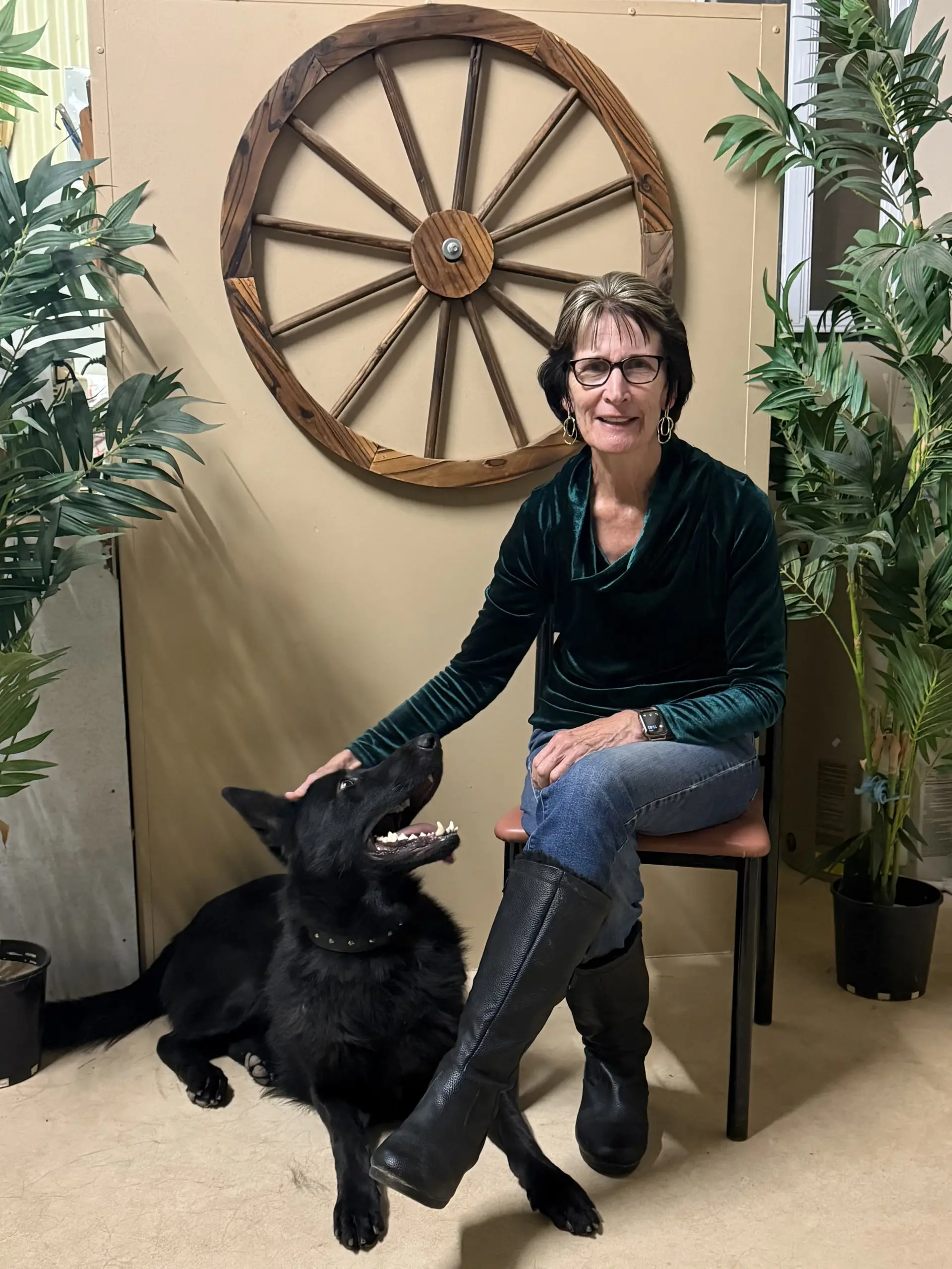
Pauline Cowey
Accredited Dog Behaviourist, Communicator, Owner Educator and Trainer based at Crystal Brook, South Australia. Decades of hands-on work resolving aggression, reactivity, anxiety and obedience cases across regional SA — through ethical, leadership-based methods.
Read Pauline’s full story →