
Service
Obedience Training That Sticks
Obedience that holds in the paddock, the beach, the cafe and the chaos — because it comes from relationship, not bribery.
In short
Dog obedience training that actually holds in the real world is not about commands. It is about leadership. Your dog responds reliably when it trusts you to lead the situation — and the cues become signals between two beings who already understand each other, not orders that require a treat to honour.
Sound familiar?
- Sits, but only when you have food
- Recalls — until something more interesting appears
- Walks fine alone, drags you everywhere when there's another dog
- Listens at home, ignores you at the park
- Knows every command and still does whatever it wants
Why this works where other methods do not
- Cue-and-treat cycles that fall apart without food
- Long-line corrections that build resistance, not respect
- Six-week courses with no transfer to real life
- Boot camps where the dog "obeys" the trainer, not you
- Behaviour rooted in trust — no bribery required
- Calm clarity that your dog reads as confidence
- Real-world application from session one
- You become the leader your dog already listens to
How it works
- 1
Free Behaviour Test
Identify what's actually driving the "obedience problem" — usually it's leadership, not training.
- 2
In-home consultation
I work with you in your environment, teaching the Five Rules and applying them to your dog's specific obedience gaps.
- 3
Real-world transfer
We move from controlled to chaotic — paddock, town, off-lead — so the behaviour holds where it matters.
Inside the process
What actually happens when we work together
An obedience consultation looks different to what most owners expect. There is very little I would recognise as conventional training — no clicker, no treat pouch, no command-and-reward cycles. What there is, in the first hour, is a lot of me sitting still and watching how you and your dog occupy a room together. The obedience gap is almost always visible in those first sixty minutes, before we have said a single command.
From there we work in the spaces obedience actually lives. The kitchen at dinner time. The hallway when the doorbell goes. The driveway when the dog wants to bolt. The paddock or beach where recall matters. We do not drill commands. We adjust the way you hold space — your posture, your voice, the angle you stand at, what you do with the lead, where your attention is — and we watch your dog rewire its default response in real time. By hour two your dog is offering loose-lead walking without anyone having taught a loose-lead exercise; by hour three it is settling on the floor unprompted while we talk.
The session ends with a written plan that names the obedience contexts that matter to your life — recall around your stock, calm at the cafe, off-lead at your local beach providing your dog has at least 90% recall, polite at the front door — and gives you a week-by-week progression. Email follow-up gives you a place to send video clips when something is not transferring, and I give you specific adjustments rather than generic advice. Most obedience cases need one in-home session followed by six to twelve weeks of email coaching; some need a follow-up in-home at the adolescent threshold. We agree what is appropriate for your case before you book anything beyond the first consult.
What changes
- Loose-lead walking from day one — no head halter, no harness gimmicks
- A recall that holds around stock, wildlife, vehicles and other dogs
- Calm waits at doors, in cars, at the cafe
- A dog that settles on its own without being told
- Reliable behaviour off-lead in regional SA paddocks, beaches and bush tracks
Who this is for
- Owners whose dog "knows the commands" but doesn't reliably follow them
- Regional families with off-lead dogs around stock, wildlife or traffic
- Anyone moving from puppy to adolescent dog (8–18 months)
- Owners who've tried group classes and want something that actually transfers home
Expected outcomes
What you’ll notice — and when
You will feel the first shift inside the first session. Your dog will look at you differently — softer, more attentive, less braced. That is not a training breakthrough; it is your dog reading the change in you. The trick is then to hold that change every day for the next month.
By the end of week one of consistent practice, loose-lead walking is the default in your driveway and immediate neighbourhood. Recall in low-distraction environments is reliable. Settle on a mat or bed without being told happens multiple times a day. Door manners are mostly intact — your dog waits at the threshold without lunging. This is not perfection; it is the new baseline.
Weeks two to six move the work into harder environments. The local park, where other dogs are visible. The street with cars and bikes. The neighbour's place. Each new context tests the obedience foundation, and each successful exposure compounds. By week six most obedience cases are reliably executing in the contexts the owner actually cares about, with occasional regressions handled by the owner without my involvement.
The longer-term outcome is a dog you can take anywhere, confident that obedience holds. Around stock and wildlife. At the cafe. At the beach. Off-lead in the paddocks behind the house. Walking past a reactive dog without engaging. The work after that is consistency — and the reason this method holds is that you are not maintaining trained behaviours, you are maintaining a relationship. The two are very different. Trained behaviours decay; relationships do not, provided you keep showing up the same way every day. Most obedience cases reach a stable plateau by the three-month mark and then run on autopilot.
Real owners. Real change.
Owners who’ve worked with Pauline on obedience training
“We are both really pleased with Arthur's progress and it's only day 3. He's almost like a new dog! Understanding the why behind Pauline's method then being consistent in our actions as pet owners is the most important takeaway we gained from our session with Pauline. Highly recommended.”
“I only wish we had engaged Pauline sooner! Our family found her in-home training session to be informative and invaluable in helping us make real change to our relationship with our 7 year old Border Collie. It was so beneficial to complete the training in person and be able to ask questions along the way. We gained a much better understanding of how our own habits and behaviors were unintentionally reinforcing the behaviors we didn't want. In just a few short weeks, by following Pauline's simple rules, we have already seen a noticeable change in our dog. The literature provided by Pauline has also been an excellent resource, helping us stay on track and reinforce what we learned. We are looking forward to calm outings with our dog in the future!”
“very informative, simple but effective methods to use.”
Where I work
Obedience Training across regional SA
Pauline travels in-home across these regions — and works online with owners anywhere in Australia.

Upper Spencer Gulf
Spanning Port Pirie, Port Augusta and Whyalla, the Upper Spencer Gulf is home to working families, working dogs, and the long open spaces that both help and hurt dog behaviour. I run regular in-person consultation days across the whole USG from my Crystal Brook base — with bookings grouped together for the longer Whyalla and Port Augusta trips so the drive carries multiple cases.
Dog training the Upper Spencer Gulf
Eyre Peninsula
The Eyre Peninsula is vast — Port Lincoln is roughly 5 hours from Crystal Brook, Ceduna closer to 8. I work in-home across the peninsula on blocked consultation days, grouping bookings together to make the drive worthwhile — and online coaching is equally available for owners who prefer it or whose case is time-sensitive.
Dog training in Eyre Peninsula
Iron Triangle
The Iron Triangle — Port Pirie, Port Augusta and Whyalla — is one of the densest regional dog populations in South Australia. Heart of the Pack is based 25 minutes south of Port Pirie at Crystal Brook and runs regular in-person consultation days across all three towns, with bookings grouped together for the longer Whyalla trips so the drive carries multiple cases.
Dog training in Iron Triangle
Mid North
The Mid North is home base. Crystal Brook sits squarely in the middle of it, and my standard rotation covers most Mid North towns within an hour's drive — Jamestown, Peterborough, Burra, Gladstone, Snowtown, Laura, Wirrabara, Quorn — with regular in-person consultation days through the week.
Dog training in Mid North
Clare Valley
Clare Valley wine-country dog life is its own thing. Tourists, dog-friendly cellar doors, dog-dense events, and a population mix of long-time locals and tree-changers from Adelaide. I run regular in-person consultation days across the Clare Valley from my Crystal Brook base — about 50 minutes south — with bookings grouped together so each Clare day carries multiple consults.
Dog training in Clare Valley
Yorke Peninsula
The Yorke Peninsula is beach country — fishing trips, tourist holidays, working sheep properties, and family dogs that range from spoilt town dogs to long-line drivers on the harvest. I run regular in-person consultation days across the peninsula from my Crystal Brook base, with bookings grouped together so the drive (90 minutes to the Copper Coast, around 2 hours to Yorketown) carries multiple consults in the same trip.
Dog training in Yorke PeninsulaSee it in action
Before and after — real obedience training consultations
Real footage from in-home consultations. Each clip is the change inside the session — not edited in post.
Luna
By the end of the consultation Luna was calm at meal times, quieter through ball games, and able to disengage on the “finish” command she had never previously respected.
Chance
By the end of the consultation Chance was greeting calmly at the door, quiet on his mat and walking beside his owner with slack in the lead.
Tiger (German Shepherd)
By the end of the consultation Tiger was settled on his mat, watching the household move around him without joining in every trigger.
Related services
Often comes up alongside obedience training
These are the services owners working on obedience training most often need to look at too. If you're not sure which category your dog fits, the Free Behaviour Test sorts it in two minutes.
Service
Puppy Training
Puppy training that begins with the relationship, not the trick — so the calm carries into adulthood.
Read moreService
Reactive Dog Training
Reactivity is over-arousal wearing a leash. Calm the arousal, the reactivity collapses.
Read moreFormat
In-Home Training
Your dog's behaviour lives in your environment. So the training does too.
Read moreRead more on this topic
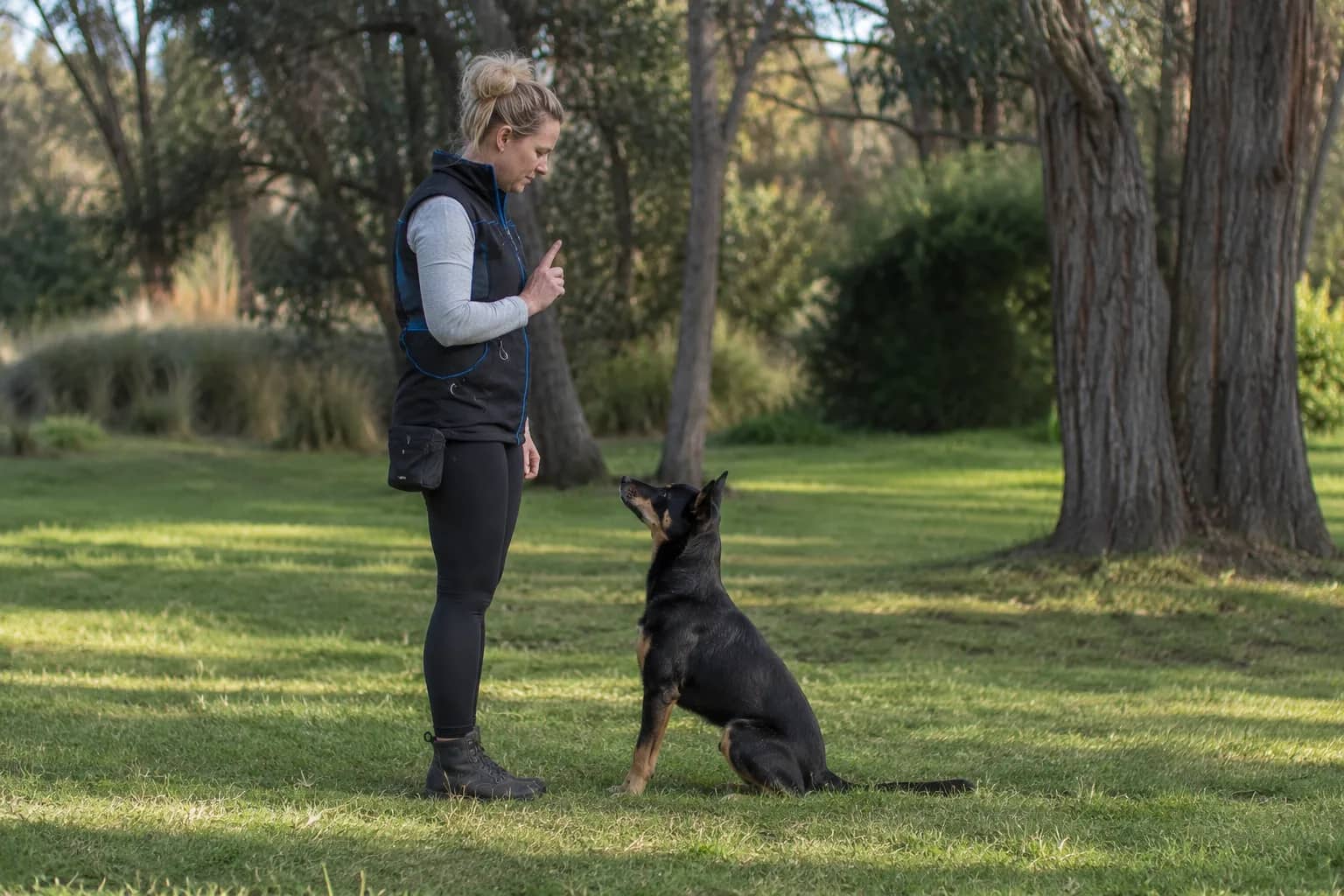
obedience leadership
Calm Leadership: The Real Reason Your Dog Won't Listen
If your dog ignores you, the problem isn't training — it's leadership. Here's what calm, clear leadership actually looks like across regional SA households.
12 min read·May 2026
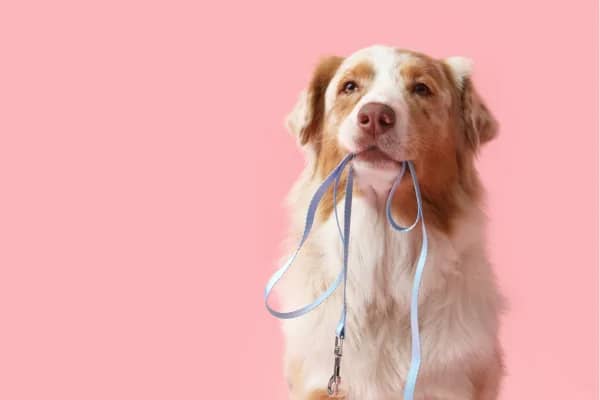
obedience leadership
Stop the Pulling: Calm Lead Walking for Your Dog
Loose-lead walking — without head halters, no-pull harnesses or gimmicks. The leadership-based method that works for regional SA dogs.
10 min read·Mar 2026
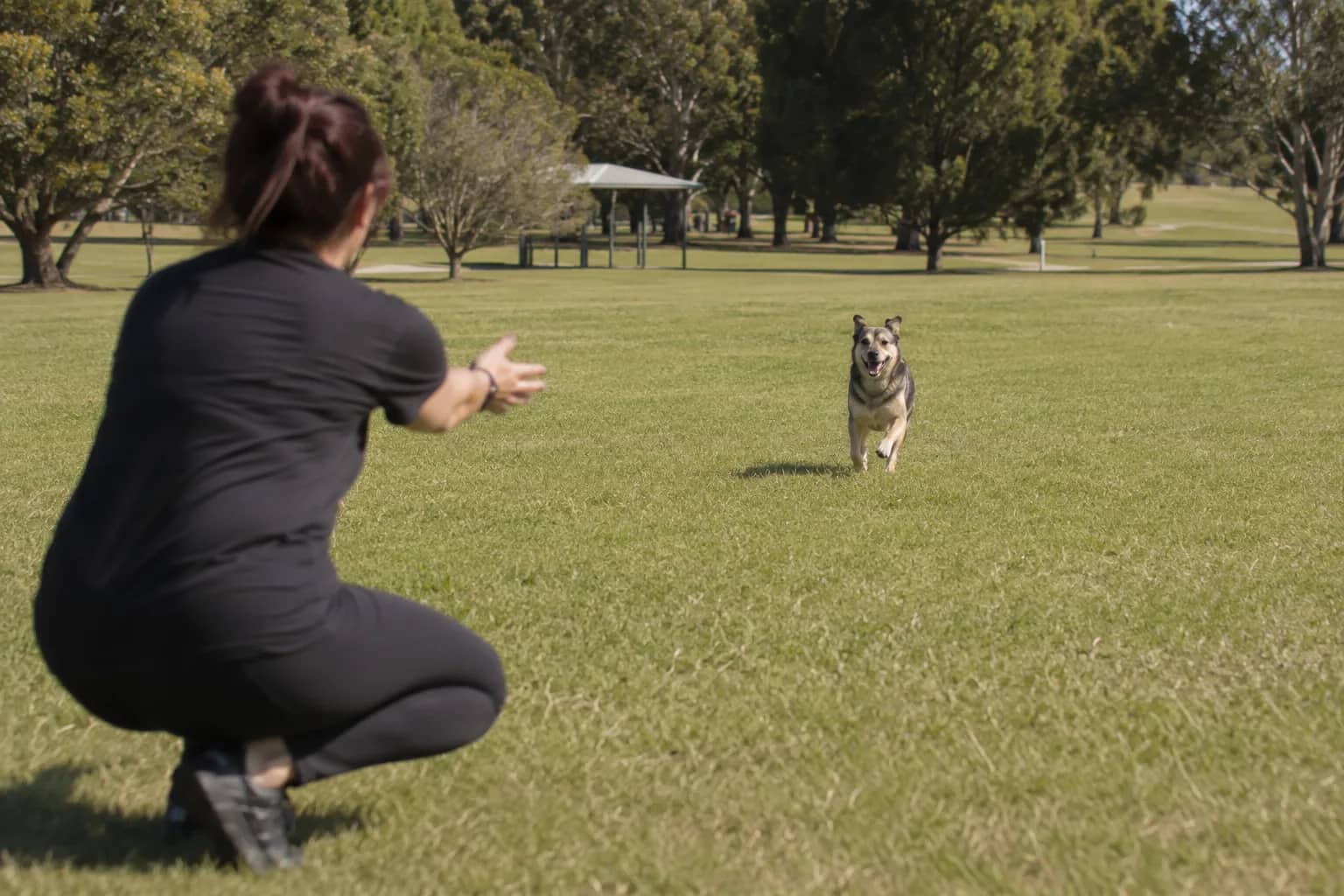
obedience leadership
Dog Recall Training That Actually Works — Regional SA
Reliable off-lead recall around stock, wildlife, beaches and bush. The leadership-based recall method for regional SA owners.
4 min read·Aug 2026
choosing a trainer
How Long Does Dog Training Take?
Realistic timelines for puppy training, loose-lead, recall, adult obedience, adolescent reset and behaviour cases. What speeds it up, what slows it.
10 min read·June 2026
Obedience Training — frequently asked questions
Start here
Find out what is really going on with your dog — in 2 minutes.
The Free Dog Behaviour Test gives you (and Pauline) a clear starting point. No pressure, no spam, no obligation — just clarity.