The Real Cost of a Dog Behaviourist — And Why Cheaper Isn't Cheaper

"How much does a dog behaviourist cost in Australia?" is the second question I hear on almost every enquiry call. The first is "will you actually be able to help." The two are connected — and the honest answer to the cost question depends on what you are actually paying for, and whether the person quoting you is a trainer, a behaviourist, or somewhere in between.
This article covers the real numbers, what they include, why they vary, and how to work out whether the fee you have been quoted is honest.
What a dog behaviourist actually costs
Across Australia, the typical fee structure for an accredited dog behaviourist looks like this:
- Phone or video pre-consultation (30–45 minutes): $80–$200. Some behaviourists offer a shorter version free.
- First in-home consultation (three to four hours): $400–$1,200 depending on state, region, travel and the behaviourist's experience.
- Follow-up consultations (in-home or online, one to two hours): $150–$500 each.
- Email or messaging support between sessions: often included in the initial fee, or bundled as a package.
- Written case plan and case file: almost always included in the first consultation fee.
The wide range is real. A Cert IV dog trainer branding themselves as a behaviourist in a metropolitan area might charge $200 for a 90-minute consultation. A fully accredited veterinary behaviourist in Sydney might charge $1,500 for a first consultation. A regional accredited behaviourist without the vet qualification typically sits in the middle — $400–$800 for the first in-home visit, which covers three to four hours of on-site work.
What you are actually paying for
The fee gap between a trainer and a behaviourist is not arbitrary. You are paying for four things that a training-only professional is not delivering.
Diagnosis. A real behaviour consultation starts with reading the case — the household, the dog's baseline state, the history, the specific triggers, the medical picture. That work takes time. Aggression cases, resource guarding, separation anxiety, severe reactivity — none of these are visible from behaviour on its own; they are visible from the pattern behind the behaviour. Diagnosing that pattern is the first hour or two of any competent consultation.
Case-specific intervention. Training programs are typically portable — the same six-session obedience protocol runs across every dog in the class. Behaviour work is not. The intervention has to fit the specific household, the specific dog, the specific triggers. That is a bespoke piece of work, and it is why behaviourists take fewer cases per week than trainers do.
In-home time. Most behaviour work happens where the behaviour lives. Trainers can work at a park or a training hall because their scope is skill-based — the skill can be built anywhere and generalised. Behaviour work almost always requires seeing the environment, the household routines, the layout of the yard, the arrival and departure patterns, the specific trigger contexts. That means longer sessions at the client's house, not shorter sessions at the trainer's location.
Accountability for outcomes. A behaviour case that goes wrong is not a stalled training program — it is a bite, a rehomed dog, sometimes a euthanased dog. Accredited behaviourists carry that liability, and the fee reflects it. Cheap behaviour work is expensive to unwind.
What the fee usually includes
A first in-home consultation with an accredited behaviourist typically includes:
- The pre-consultation intake and history review
- Three to four hours of on-site work with the household and the dog
- A written case plan delivered within 48 hours of the visit
- Email or messaging support for four to eight weeks after the visit
- Referral to a veterinary partner if pain or medical factors need ruling out
- Coordination with your veterinarian on any medication decisions
Follow-up work, when needed, is usually charged separately at a lower per-hour rate. Some behaviourists offer packaged fees — the first consultation plus a nominated follow-up window — which can be worth it for cases that are known to need more than one visit.
What drives cost variation
Five factors move the fee up or down.
State and region. Sydney and Melbourne behaviourists charge more than regional behaviourists. This is not because the work is different — it is because rents, insurance and market rates are different. Regional South Australia, in particular, sits well below the metropolitan Australian median.
Qualification level. A registered veterinary behaviourist (with veterinary training on top of behaviour accreditation) charges more than an accredited behaviourist without the vet qualification. For most household behaviour cases, the vet-behaviourist adds unnecessary cost — but for cases where medication is likely to be a significant part of the intervention, or where there is a medical mystery underneath, the vet qualification earns its fee.
Case complexity. Some behaviourists offer tiered fees — a standard case rate and a higher rate for complex aggression or bite-history cases that require additional time, planning and follow-up. This is honest pricing when it is disclosed upfront.
Travel. Regional behaviourists often batch geographic areas into consultation days to keep travel costs down. Some include a travel loading for longer drives; others include it in the base fee and cap it at a fixed amount. Ask.
Experience. Ten years of case-specific experience is not the same as ten years of running puppy classes. A behaviourist who has personally worked hundreds of aggression cases charges more than someone who has taken the same qualification and is early in their career. Both can be right for different cases.
Why cheaper is often more expensive long-term
Cheap behaviour work has predictable failure modes. The dog gets a training program layered on top of an unresolved behaviour problem. The trigger keeps rehearsing while the training stalls. Six months later the household is back where it started — plus six months of habit deepening, plus the money already spent.
The cases I take most often are the ones that have already been through one or two cheap attempts. A $250 "behaviour session" from a trainer without behaviourist qualification. A six-week package from a chain training school. A YouTube protocol. Each of these can look like a bargain on the day. None of them resolve a real behaviour case, and the household ends up paying for the specialist work anyway — just with an extra six months of rehearsal to unwind first.
That is not an argument for paying the highest fee. It is an argument for paying an appropriately-qualified fee once, rather than an under-qualified fee three times.
Red flags on either extreme
Too cheap. A $150 "behaviour consultation" that runs for 60 minutes is not a behaviour consultation. It is a training session with a different label. Real behaviour work does not fit in 60 minutes for a first visit.
Too expensive with no accountability. A quote in the four-figure range that comes without a written case plan, without follow-up support and without clear coordination with a veterinarian is not value for money — it is a premium fee attached to a shallow deliverable. Ask what is included before you agree to the fee.
Guaranteed results. No competent behaviourist guarantees a specific outcome by a specific date. The dog and the household do the work; the behaviourist plans and coaches it. Guarantees are marketing, not clinical practice.
Insurance, rebates and tax deductions
Pet insurance in Australia does not typically cover behaviourist fees. Some premium policies have started to include a small behaviour allowance (a few hundred dollars per year); check your specific product before assuming.
Service dogs, working stock dogs and dogs used for a business (farming, security, therapy work) may attract different tax treatment. Speak to your accountant.
There are no Medicare-style rebates for dog behaviourist consultations, but veterinary behaviour work is treated as a veterinary service — worth knowing if your case is heavily medical and being run through a vet-behaviourist rather than a behaviour-only professional.
How to think about the investment
A first consultation with an accredited behaviourist costs less than most owners assume, and usually resolves a problem the household has been living with for months or years. Framed against the cost of not resolving it — a chewed doorframe, a bite, a broken relationship with the dog, a household walking on eggshells, sometimes the eventual surrender or euthanasia of a dog that could have been kept — the fee is small.
That framing is not marketing. It is what the numbers actually look like for real cases. The failed cases that come back through my calendar have almost universally spent more on the wrong professionals than the right one would have cost.
What to expect from Heart of the Pack specifically
For clarity — since this is my site — the standard consultation fee covers up to four hours of in-home consultation and professional guidance. That includes the written case plan, the email support window, and coordination with your veterinarian on any medical or medication conversations. Travel is bundled where the town sits inside my standard rotation and quoted transparently where it doesn't. There is no "package" upsell built into the initial fee; if follow-up work is needed, it is booked separately.
If you would like a specific quote for your case, contact me directly and I will send back the number in an email. If you're not sure whether you need a behaviourist or a trainer yet, take the Free Behaviour Test — it takes two minutes and points you at the right professional. And if you want the broader comparison, dog behaviourist vs dog trainer covers the scope-and-method distinction in detail.
Not sure where to start with your dog?
Take the Free Dog Behaviour Test.
Two minutes. You’ll find out exactly what’s driving your dog’s behaviour — and what to do next.
Frequently asked questions
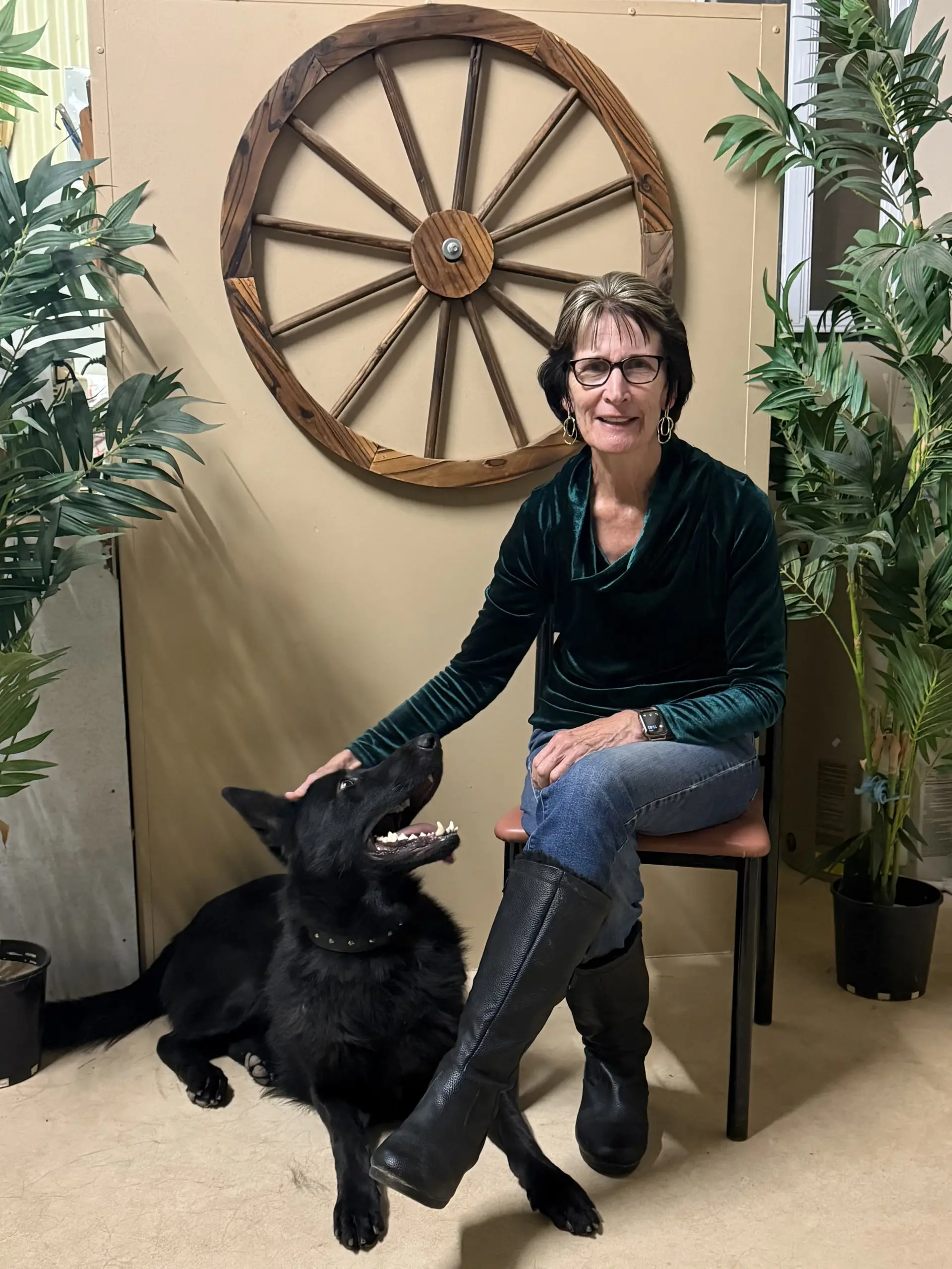
Written by
Pauline Cowey
Accredited Dog Behaviourist, Communicator, Owner Educator and Trainer based at Crystal Brook, South Australia. Decades of hands-on work resolving aggression, reactivity, anxiety and obedience cases across regional SA — through ethical, leadership-based methods.
Read Pauline’s full story →