In-Home vs Group vs Online: Which Dog Training Format Is Right?

Four formats, four use cases. In-home wins for behaviour cases and multi-dog households. The Crystal Brook Studio works for households whose home environment is heavily triggering the dog, or owners driving in from outside the in-home catchment. Group is rarely the right answer for regional SA owners (and is increasingly hard to access). Online works better than most people expect — especially for habit-based issues. Here's how to choose.
If you live in Port Pirie, the Clare Valley, or anywhere across regional South Australia, your dog training options look very different to a metro Adelaide owner's. Group classes are rare. The "puppy school down the road" usually isn't down the road. So the choice between in-home, studio, group and online is more consequential — and often more clarifying.
Here's how to think about it.
What each format is good at
In-home behaviour consultation
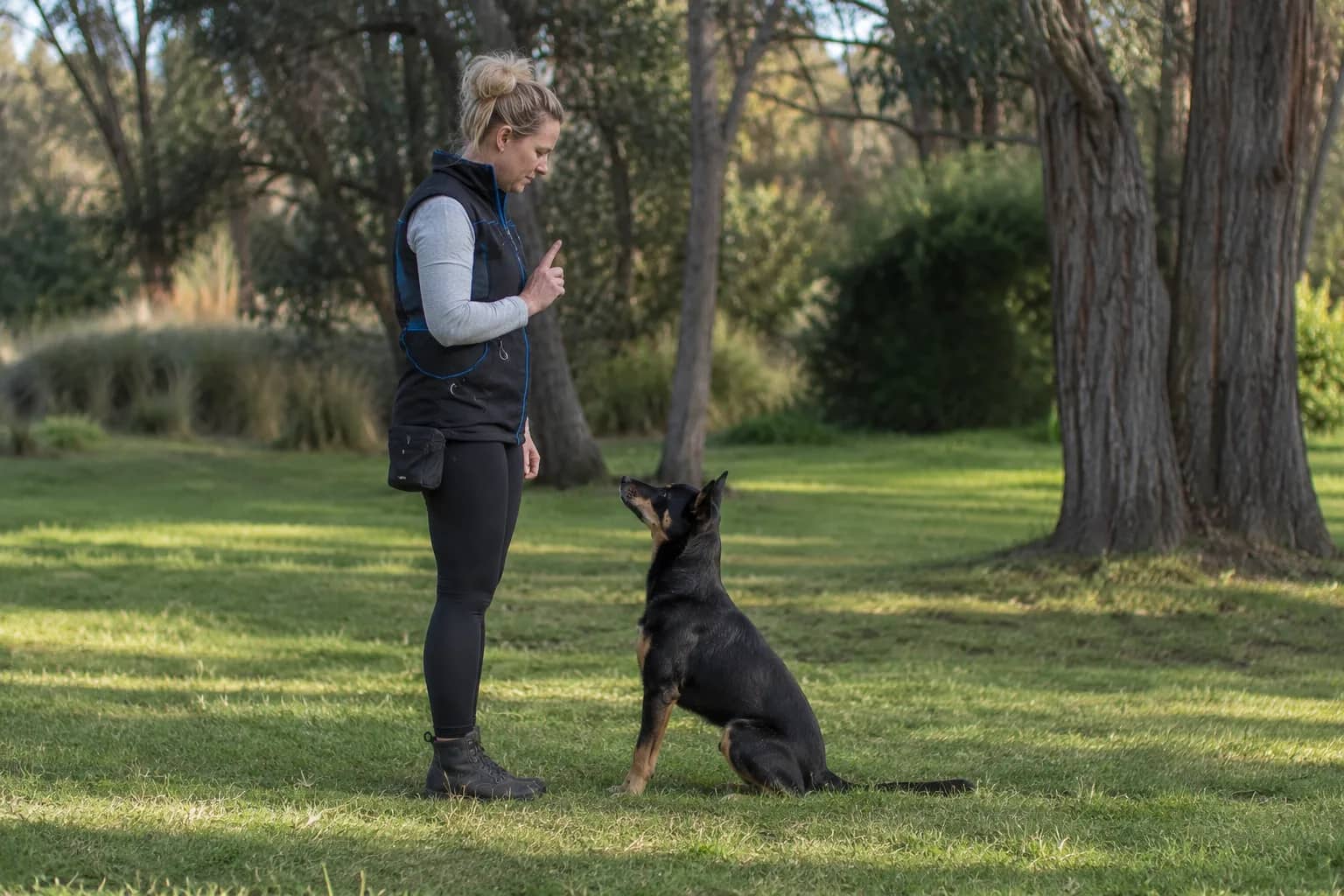
A behaviourist comes to your home for a long session (3.5–4 hours), observes the dog in its real environment, and coaches the family on what to do. Single-session model with email follow-up; ongoing for serious cases.
Best for:
- Aggression and reactivity
- Anxiety (separation, generalised, noise)
- Resource guarding
- Multi-dog household dynamics
- Whole-family alignment
- Puppy training (when you want a foundation that holds)
- Anything where environment matters (most cases)
Less ideal for:
- Pure socialisation for confident puppies in densely-populated areas (where group classes exist)
- Owners outside the in-home travel radius
Crystal Brook Studio consultation
Same method as the in-home consult, different environment. You bring your dog to Pauline's dedicated training room at her Crystal Brook home for a 2–3 hour session — purpose-built, neutral, distraction-free. You stay with your dog the whole time; this isn't a drop-off service.
Best for:
- Households whose home environment is heavily triggering the dog (we need a neutral space to start)
- Owners outside the in-home catchment who can drive in for a focused single session
- Working-breed adolescents needing a leadership reset away from household triggers
- Rescue dogs starting behaviour work in a neutral space rather than the new home
- Tune-ups and follow-ups after an earlier in-home consultation
Less ideal for:
- Severe aggression cases where the dog is unsafe to transport
- Reactive dogs whose primary trigger IS the home environment (in-home wins)
- Whole-family cases where everyone needs to be present in the household
- Owners outside reasonable driving distance from Crystal Brook
More on the Crystal Brook Studio →
Group classes
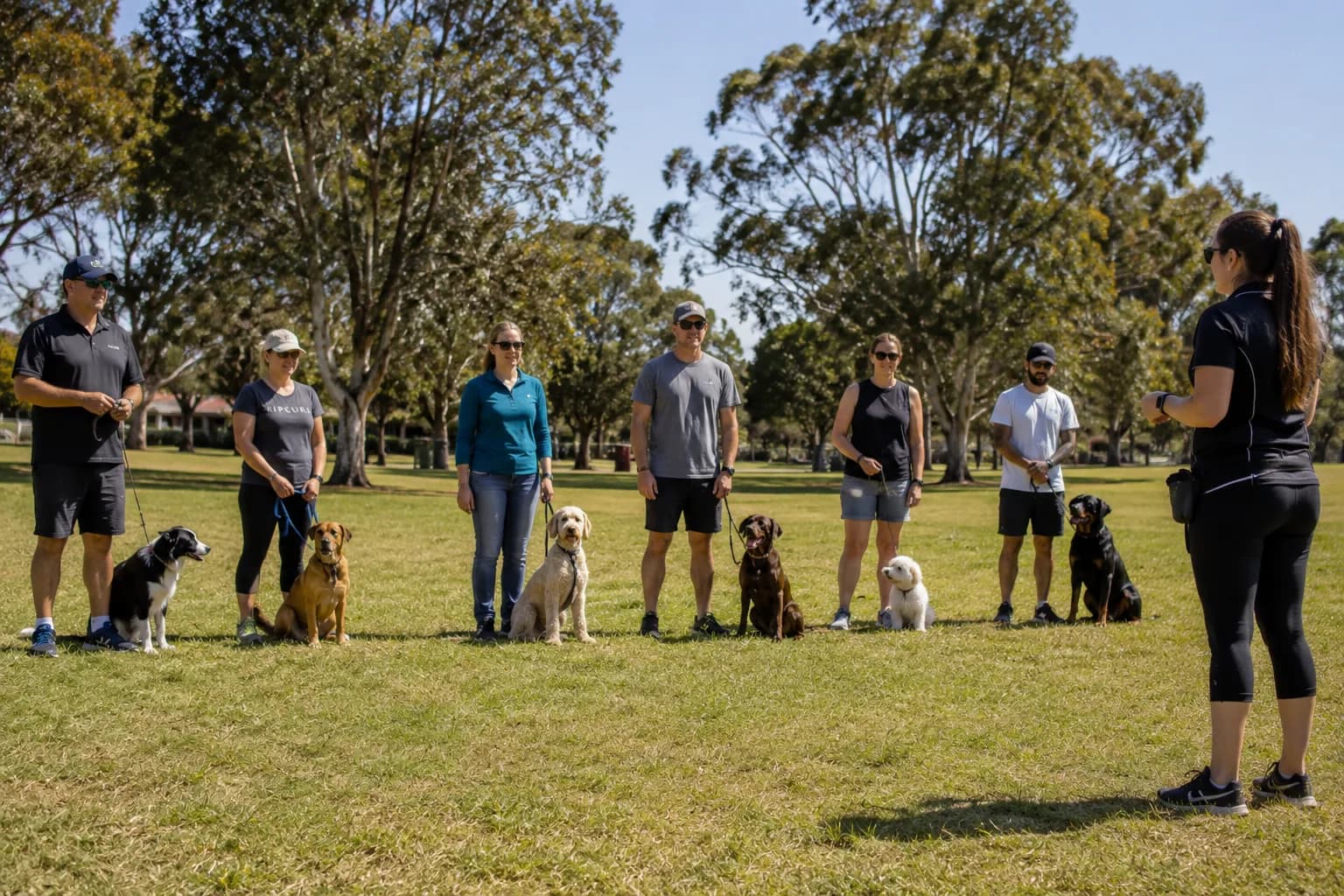
A trainer runs a class of 4–8 dogs and their owners in a hall or yard, weekly, for 6–8 weeks. Owners learn skills; dogs learn skills; the social environment is the curriculum.
Best for:
- Confident puppies in their critical window (where you have access)
- Foundational sit/stay/recall for already-stable dogs
- Owners wanting community / a learning environment
Less ideal for:
- Aggression or reactivity (often unsafe and unproductive)
- Anxiety cases
- Multi-dog households
- Cases where environment matters (so… most cases)
- Regional SA owners (often not accessible)
Online behaviour coaching
Live video consultation (often 60–90 minutes) plus ongoing async support — the owner sends clips of progress, the behaviourist reviews and adjusts the plan. The behaviourist sees the real environment via the owner's camera.
Best for:
- Owners outside in-home travel radius (Eyre Peninsula, Far North, interstate)
- Separation anxiety (often better than in-home)
- Demand behaviour, recall, leadership work
- Habit-based issues
- Owners with flexible schedules / async preferences
Less ideal for:
- Severe aggression cases needing immediate environmental work
- Owners who won't put the phone down and show the real environment
- Cases requiring physical handling guidance
When each is the wrong choice
When group classes are the wrong choice
If your dog has shown any aggression, reactivity, fear or anxiety — group is almost certainly the wrong format. The dog can't learn in that environment. The other dogs and humans aren't there to be your dog's exposure ladder; they're there for their own training.
You wouldn't send a child with severe anxiety to a 20-kid birthday party as their first social experience. Same principle.
When in-home is the wrong choice
If your dog's issue is genuinely format-agnostic — pure separation anxiety, demand behaviour, owner-habit issues — online may produce the same result for less cost and travel.
If you're outside the realistic in-home radius (Eyre Peninsula deep, Far North), waiting months for an in-home visit is worse than starting now online.
When the studio is the wrong choice
If your dog's primary trigger lives at your home — fence-line reactivity, doorbell anxiety, front-yard postal worker patterns — bringing the dog to a neutral space won't engage the problem. In-home wins. The dog needs to learn the new pattern at the location where the old pattern was rehearsed.
If your case needs the whole household present — multi-dog dynamics, children who are central to the case — in-home wins for the same reason. You can't bring the whole household to the studio in a useful way.
If you're more than 90 minutes from Crystal Brook, online coaching is usually a better starting point than driving the dog in. The studio works best for owners within reasonable drive distance who want a neutral start.
When online is the wrong choice
Severe aggression where environmental management requires being physically there. Multi-dog households with specific dynamics that need to be observed. Owners who can't get the camera angle to show the real environment.
Even then — online can often start the work, with an in-home follow-up later.
The biggest misconception about online
Most owners think online coaching is "second-best" or "in-home lite." For most cases, it isn't. Online is often the optimal format because:
- The behaviourist sees your real environment, not a clinic
- The dog is in its natural state, not stressed by travel
- You learn to handle the dog yourself, with the behaviourist coaching — rather than handing the dog over
- Async support between sessions means progress is tracked, not just hoped for
- Schedule flexibility means you can do work at your dog's best time, not the trainer's
For separation anxiety specifically, online is often the only sensible format — you can't observe an SA dog with the trainer in the room (the trainer's presence resolves the trigger).
A decision tree
Roughly, here's how to choose:
Has the dog shown aggression, escalating reactivity, or fear-based behaviour? → In-home if within radius; in-home + online hybrid if not; never group.
Is your home environment heavily triggering the dog — every doorbell, every fence-line walk-past, every car in the driveway escalates it? → The Crystal Brook Studio for the first session, then transfer the work home. In-home if you'd rather start at home from day one.
Are you outside the standard in-home rotation but want a single focused session in person? → The Crystal Brook Studio (you drive in, no in-home travel cost on Pauline's side).
Do you have a multi-dog household with internal dynamics? → In-home.
Is this a stable, confident puppy under 16 weeks and you have access to a well-run puppy class? → Group can be useful for the socialisation piece; supplement with in-home puppy work for the leadership foundation.
Is your issue predominantly habit-based (separation anxiety, demand behaviour, recall, leadership gaps)? → Online is often the best format.
Are you on the Eyre Peninsula or further from Crystal Brook than 2 hours? → Online for most cases; in-home only for severe cases warranting the travel.
Are you within an hour or so of Crystal Brook? → In-home is usually the most efficient.
Cost considerations
People assume in-home is the most expensive option. It often isn't — when you account for what it actually delivers.
A single in-home consultation is typically equivalent to 4–6 group class sessions in cost — but delivers what group classes can't (real environment, whole family, full case-specific plan). For behaviour cases, this is dramatically more efficient.
The Crystal Brook Studio sits between in-home and online on cost — slightly less than a long-distance in-home consult (no travel cost on Pauline's side), more than online because you're getting a full in-person session in a neutral space. For owners further from Crystal Brook, the studio is often the most cost-effective way to get in-person work without the in-home travel surcharge.
Online is usually the lowest cost per hour and the most flexible — but it requires owner discipline (showing up to live sessions, sending clips, executing the plan).
Group is usually the lowest cost per attendance, but the total cost (including the cases where it doesn't work and you end up needing in-home anyway) often makes it the most expensive in the end.
What about "board and train"?
Board and train (sending your dog to a trainer for 1–4 weeks) is sold heavily in metro markets and is showing up in regional SA. I don't recommend it.
The reason: the dog isn't the problem. The household is the relationship system the dog responds to. A trained dog that returns to an unchanged household reverts within weeks.
If you're considering board and train, redirect the budget to in-home or online instead — same money, dramatically better outcome.
How to decide what's right for you
If you're not sure, take the Free Behaviour Test. It'll tell you what type of case you have, which is the strongest signal for which format fits.
If you'd rather just talk through it, contact Pauline directly. She'll be honest about whether your situation suits in-home, online, or whether you should be looking elsewhere entirely.
The right format saves you months. The wrong format costs you a year and often makes things worse. It's worth thinking about.
Not sure where to start with your dog?
Take the Free Dog Behaviour Test.
Two minutes. You’ll find out exactly what’s driving your dog’s behaviour — and what to do next.
Frequently asked questions
Written by
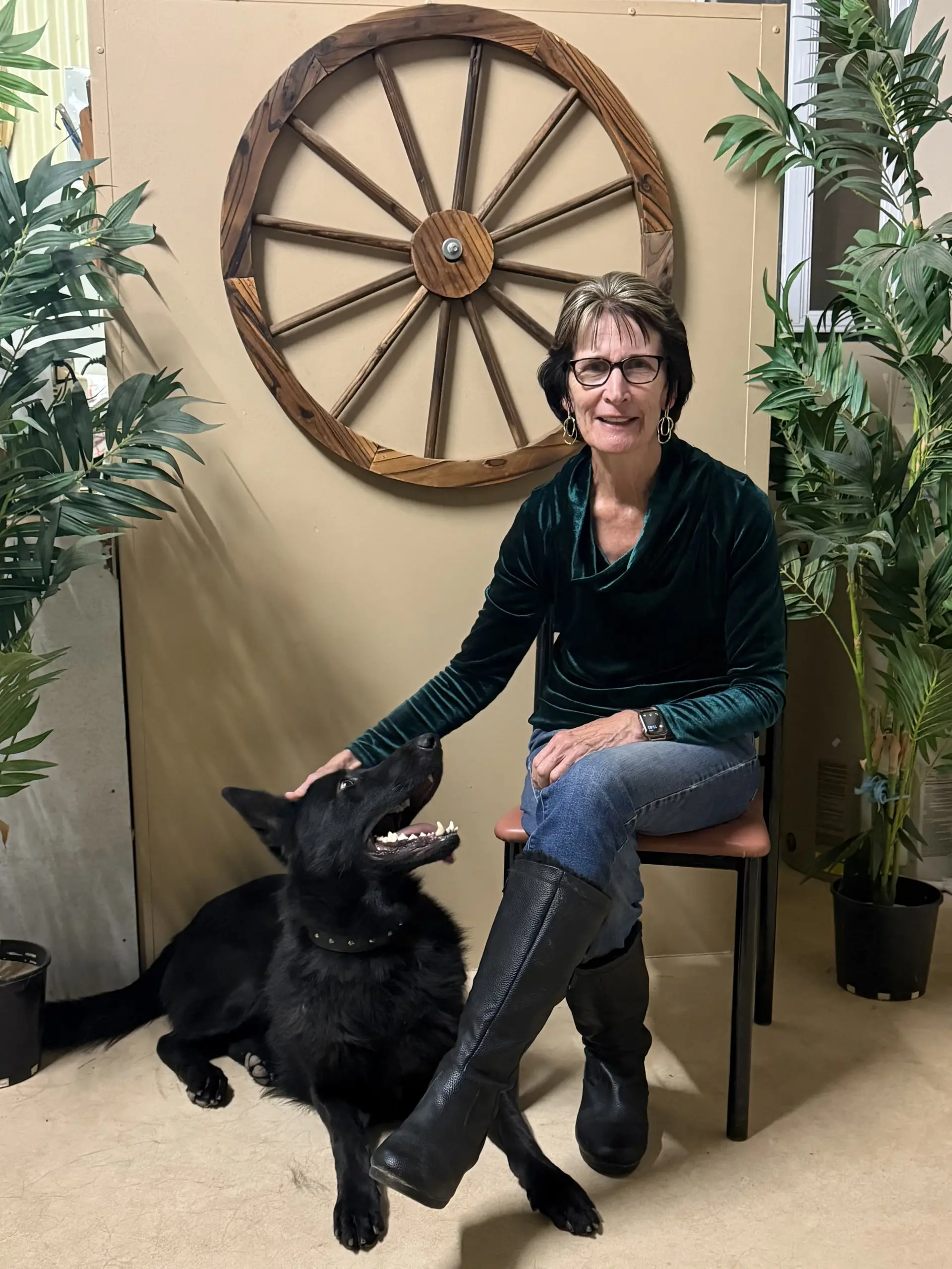
Pauline Cowey
Accredited Dog Behaviourist, Communicator, Owner Educator and Trainer based at Crystal Brook, South Australia. Decades of hands-on work resolving aggression, reactivity, anxiety and obedience cases across regional SA — through ethical, leadership-based methods.
Read Pauline’s full story →