Family-Safe Dogs with Young Kids — Rules for the House, the Dog and the Children

Every household with young kids and a dog is running a two-way training project — training the dog to be safe around the kids, and teaching the kids to be safe around the dog. Households that do only half the work get bites. Households that do both, done well, get the family dog they hoped for.
This piece covers what genuinely makes a dog household-safe with young children, the household rules that matter most, the warning signs that mean the case needs professional eyes on it immediately, and why the age of the youngest child changes what needs to be in place. It doesn't lay out the specific in-home methodology I use during a family consultation, but it does give the framework needed to run a safe household while professional help arrives.
The short version
A family-safe dog with young kids requires household rules that apply to everyone, a dog that has been shaped to accept child-adjacent unpredictability, children who have been taught what not to do around the dog, a guaranteed safe space the dog can always retreat to, and adult supervision of every direct interaction until the kids are old enough to read canine body language reliably (roughly age eight, and even then supervised). Warning signs that mean immediate professional help: growling at a child, snapping, resource guarding around a child, or any incident that could have gone worse than it did.
Why "the dog would never bite" is the wrong frame
Almost every serious bite case involving a child comes from a household that would have said, a week earlier, that the dog would never bite. The dog usually has warned — often for months — with signals the household misread as "grumpy" or "just doesn't like being disturbed." The bite arrives on a day when the child moved unpredictably, the dog was in an unusual state, or a small change in the environment stacked with the pattern that was already there.
The right frame is not "will this dog bite" — most dogs won't. The right frame is "am I running a household that would prevent a bite even if this dog were about to." Because you cannot know in advance. You can only build the household that prevents it.
That means:
- The dog has clear boundaries and structure it can count on
- The children have clear rules about the dog they can count on
- The interactions are supervised at an age-appropriate intensity
- The dog has a place to go that is genuinely off-limits to the kids
Households that run those four make bites vanishingly unlikely regardless of the specific dog. Households that skip any of the four rely on luck.
Household rules the whole family applies
The single biggest predictor of a safe family-dog household is consistency across all household members. If Mum enforces a rule and Dad doesn't, if the older sibling is careful and the younger sibling isn't, the dog cannot rely on the rule and the rule doesn't work.
The dog's bed and resting spot are off-limits to everyone. No exceptions. Kids do not climb on the bed. Kids do not disturb the dog when it's on the bed. The dog learns that the bed is a genuine sanctuary and starts using it when it needs to disengage.
No handling the dog while it's eating, chewing, or has a resource. Not to "test" it, not to "prove" it's fine. Resource-guarding bites are among the most preventable in the family-dog case load.
No hugging, no face-approach, no leaning-over. All three are child-natural and dog-unnatural. Dogs tolerate them from the humans they trust; they don't tolerate them from every visiting child. The household rule is calm side-approach, calm hand offered low, wait for the dog to come to the child rather than the child to the dog.
No cornering. The dog needs an exit from any room a child is in. This is why the "guaranteed safe space" rule matters — but also why furniture layout matters. Dogs cornered against a wall, a couch, or under a table have no options left except to warn or bite.
One person handles the dog at a time. Two kids simultaneously interacting with the dog stacks arousal and unpredictability. One at a time, adult-supervised, keeps the situation readable.
What children need to learn
Age-appropriate rules for the kids matter as much as the training work on the dog.
Kids under 6. They are physically unable to read canine body language reliably and cannot self-manage their movement around the dog. The household rule for this age is: never unsupervised with the dog, ever. Not in the same room, not in the yard, not "just for a minute." Physical separation when unsupervised (baby gates, closed doors, crate) is not overprotective — it is standard practice for this age.
Kids 6–10. They can start learning the household rules and following them, but they still cannot read subtle warning signs (whale eye, low tail carriage, freeze) reliably. Supervised interactions only. Teach the rules explicitly and reinforce them constantly. Show them what a "leave the dog alone" moment looks like.
Kids 10+. They can begin to read canine body language and self-manage. Direct supervision can loosen for longer periods, but the household rules still apply. Never in the room with the dog alone if the dog has any behaviour history — even a mild one.
Every age gets the same three universal rules taught explicitly:
- Do not approach the dog when it's on its bed
- Do not touch the dog when it's eating or chewing
- If the dog moves away from you, don't follow
The guaranteed safe space
Every family dog needs one place in the house where the kids do not go. Not "usually don't" — never. This is non-negotiable and is the single most protective feature of a well-run family-dog household.
The safe space is:
- A specific bed, crate, or corner
- In a quiet part of the house (not the middle of the living room)
- Off-limits to the children as a household rule everyone applies
- The place the dog knows it can retreat to if the situation gets too much
A dog with a reliable safe space uses it. A dog without one either learns to tolerate the discomfort (until it doesn't), or develops behaviours to create distance (moving away, growling, snapping).
Warning signs that need immediate professional help
Book a behaviourist immediately if any of these happen:
- The dog has growled at any child, even once
- The dog has snapped at any child, even in "play"
- The dog resource-guards food, toys, or resting spots around a child
- Any bite has occurred, no matter how minor
- The dog has begun avoiding the children — moving out of rooms when they enter, hiding, or showing displacement behaviour (excessive licking, appeasement grins)
- Anyone in the household — parent, child, visiting relative — feels genuinely uncertain about the dog around the kids
"Immediately" means within days, not weeks. This is the specific category of case where late intervention has produced my hardest cases. Households that book at the first growl usually resolve the case with structured work. Households that wait until the second or third incident are much harder to turn around.
Do not attempt to "fix" a growl by correcting the dog for it. That is exactly the intervention that produces bites without warning. If your dog is warning around your kids, the warning is doing its job — the fix is to change the household pattern so the dog stops needing to warn.
When the case needs to change
Some family-dog cases genuinely cannot be safely maintained in a household with young children. This is a small minority — most family-dog cases resolve with good work — but it is real. Signs that the household situation may not be safe long-term:
- Bite history with any real damage
- A dog whose fear or reactivity is escalating despite competent intervention
- A young dog whose temperament genuinely doesn't fit household life with unpredictability
- A family situation where the required supervision cannot practically be maintained (single parent, multiple young kids, complex household)
The honest conversation about whether a specific dog and a specific young family can safely coexist is one every behaviourist has occasionally. It is not a failure conversation — it is a safety conversation. Any behaviourist who won't have it isn't the right behaviourist for the case.
What to do next
If your household is running the framework above and things are going well, the most useful next step is to keep running it as the kids grow. Rules that were installed at 3 years old still apply at 6, and 9, and 12.
If any of the warning signs above are present, book a consultation directly and mention the child in the enquiry — cases with children in the household get prioritised on the calendar. Or take the Free Behaviour Test — it will tell you within two minutes whether your case is normal household management or something a behaviourist should look at first.
The related reading covers the wider household pattern: calm leadership — the real reason your dog won't listen applies directly to family-dog work; when to see a dog behaviourist covers the specific triggers that make family-dog cases urgent; dog aggression training — what actually works covers the rehabilitation shape for cases that have already crossed into aggression.
A family-safe dog is a household achievement, not a dog achievement. The work is worth it.
Not sure where to start with your dog?
Take the Free Dog Behaviour Test.
Two minutes. You’ll find out exactly what’s driving your dog’s behaviour — and what to do next.
Frequently asked questions
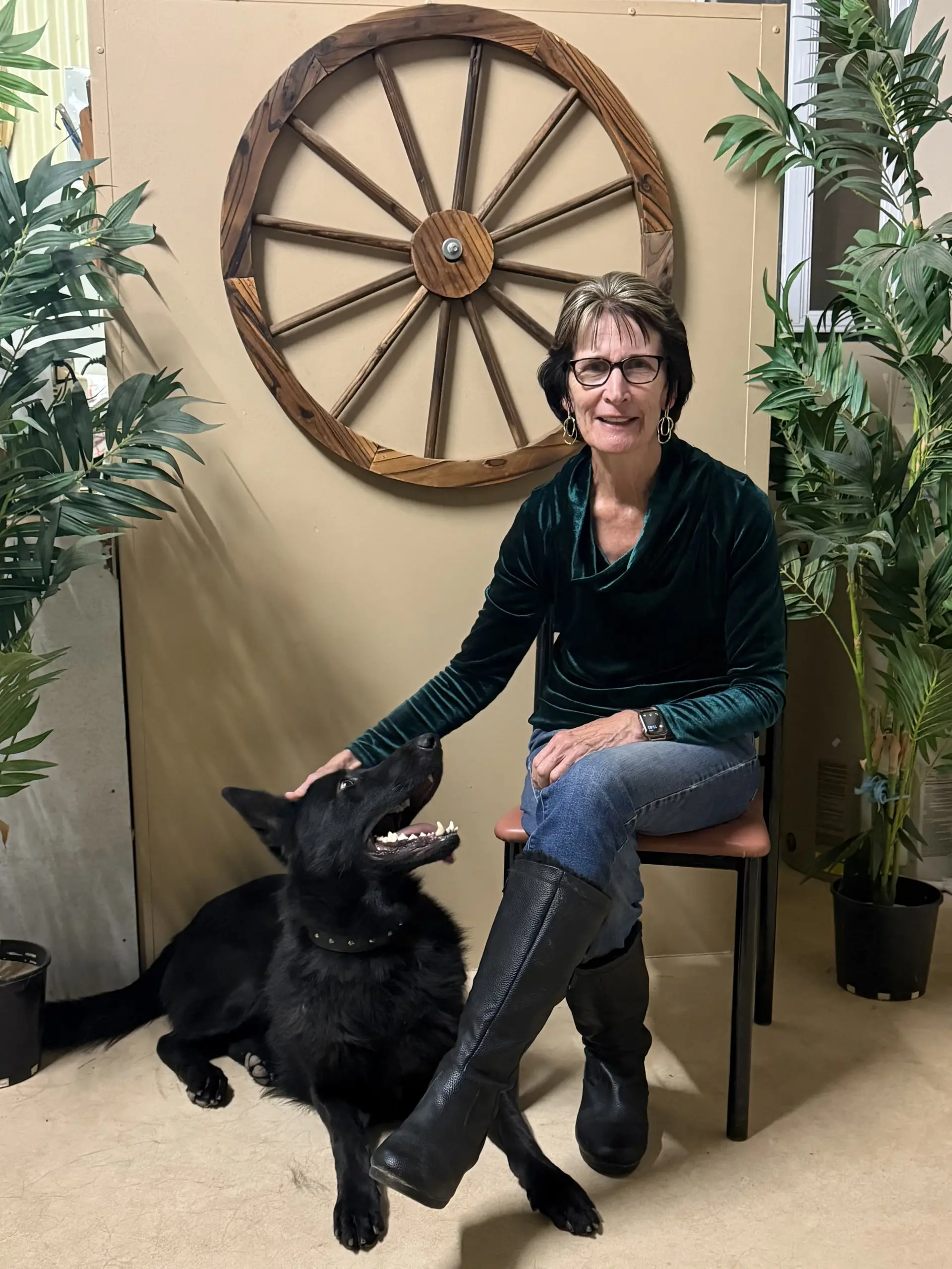
Written by
Pauline Cowey
Accredited Dog Behaviourist, Communicator, Owner Educator and Trainer based at Crystal Brook, South Australia. Decades of hands-on work resolving aggression, reactivity, anxiety and obedience cases across regional SA — through ethical, leadership-based methods.
Read Pauline’s full story →